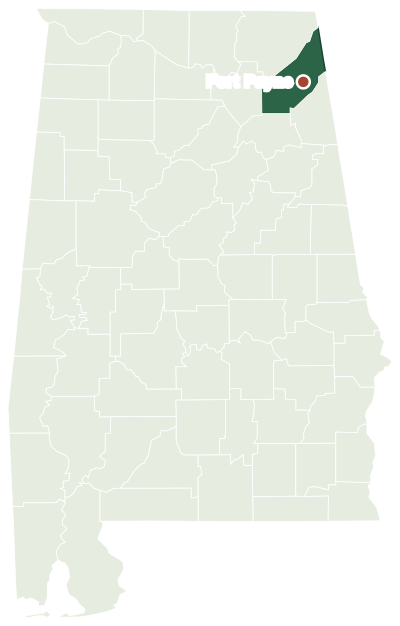
DeKalb County seat · Lookout Mountain
Fort Payne Crane Certification Prep, Valley to Mountaintop
Fort Payne once had around 150 sock mills and called itself the Sock Capital of the World. Imports cut that industry deeply after 2000, but mill buildings, surviving hosiery plants and new employers still line the valley at the foot of Lookout Mountain, with Interstate 59 running through toward Chattanooga and Birmingham. Our online course gives DeKalb County operators, riggers and signal persons a flexible way to study for accredited crane certification written exams.
From sock mills to mixed industry
The W. B. Davis Hosiery Mill grew into the town's largest employer and helped give Fort Payne its nickname. At the industry's peak, local mills employed more than half the town's residents. Then imports took their toll: by 2008 the DeKalb Economic Development Authority said the county had lost about two-thirds of its 6,000 sock jobs since 2005, and Gildan moved its U.S. sock finishing work to Honduras that year.
Renfro kept a large Fort Payne plant and was reported as the city's biggest employer, with a Walmart commitment expected to bring about 442 jobs to the facility. Smaller makers such as Zkano carry the knitting tradition on at a smaller scale.
Why old mills mean crane work
Every time a mill changes hands or changes purpose, machinery comes out and something else goes in. Knitting machines, dye vats and boilers have to be lifted through roof hatches or loading docks, and older buildings may have floors and roof structures that were never meant to carry modern equipment. That makes rigging, load path planning and communication between the operator and the person signaling just as important as the crane's capacity.
Demolition and re-roofing of older industrial buildings also bring partial loads, unknown weights and deteriorated pick points. The Rigger Level II course covers estimating weights and planning lifts when the drawings are missing.
Mountain terrain and weather
Fort Payne lies in a narrow valley with Lookout Mountain on one side and Sand Mountain on the other. Sites up on the mountain mean grades, rock close to the surface and tight access roads for cranes and support trucks. Wind behaves differently along the ridge than in town, and a pick that's calm at the bottom of the hill can be gusty at the top.
Northeast Alabama gets severe spring storms and tornadoes, summer heat and humidity, and occasional winter ice that can close mountain roads and coat booms.
Little River Canyon and the parks on top of the mountain draw visitors, and work on overlooks, park buildings and mountain roads tends to involve small cranes on tight footprints. Plan where the support trucks will stage before the crane arrives, because turning around on a mountain road is not always possible.
No local license, one federal standard
DeKalb County and the State of Alabama don't license crane operators. Federal OSHA is the agency for private employers, and its construction crane rule requires accredited certification plus an employer evaluation for operators, along with qualified signal persons and riggers. Georgia, a short drive east, follows the same federal arrangement. Read our Alabama requirements guide for the details.
Questions people ask
Where do Fort Payne candidates go for practical exams?
Chattanooga is roughly 50 miles northeast on I-59 and I-24, and Birmingham is the other direction on I-59. Many candidates test at an event arranged by their employer. The written exam can be taken by online proctoring.
What is the difference between Rigger I and Rigger II?
Rigger Level I covers basic rigging tasks done under direction. Rigger Level II adds weight estimation, center of gravity and lift planning for more complex jobs.
Is the course useful for mill maintenance staff?
Yes, especially the rigging and signal person courses. Overhead cranes inside a plant fall under OSHA's general industry rule, 29 CFR 1910.179, but the rigging knowledge applies everywhere.
How do I enroll several employees?
Use the enrollment form and list how many people and which courses. An enrollment advisor will reply.
Last reviewed · How we research these pages
Suggested prep for this area
-
Mobile Crane Operator
Self-paced study for the NCCCO mobile crane Core exam and the LAT, TLL and TSS specialty exams, organized around the hydraulic and lattice machines Alabama contractors actually rent and own.
-
Rigger I
Online written-exam study for the NCCCO Rigger Level I credential: the person who selects gear, inspects it and attaches routine loads whose weight and balance point are already known.
-
Rigger II
Self-paced written-exam preparation for NCCCO Rigger Level II, the advanced credential for riggers who work out weights and centers of gravity themselves and set up non-routine picks.
-
Signalperson
Self-paced preparation for the NCCCO Signalperson written exam, covering the standard hand signals, voice communication, crane behavior and the OSHA rules that decide when a signal person is required.
Close by
Line up your crane exam prep for work in Alabama
Send us the card you need, whether that's operator, rigger, signal person or a recert, and the part of Alabama you work in. An enrollment advisor writes back with a matching course and the steps for booking your written and practical exams.
- Self-paced lessons that open on any phone or laptop
- Practice questions in the style of the NCCCO written tests
- Advice on where Alabama candidates set up practical exams
Ask about enrollment
A few short fields. Your details are used only to reply to you.