Birmingham · Bessemer division · Online NCCCO prep
Crane Certification Across Jefferson County and the Birmingham Metro
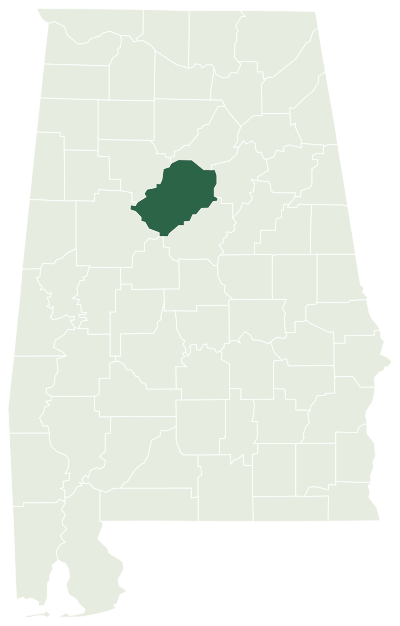
Birmingham was founded in 1871 at the crossing of two railroads, in a valley that held iron ore, coal and limestone within a few miles of each other. That geology made Jefferson County the iron and steel center of the South, and heavy industry never fully left. Today the county mixes working mills and pipe foundries with logistics hubs, medical construction and suburban growth along the interstates. County business runs through two courthouses, the main one in Birmingham and a second serving the Bessemer division. For operators, riggers and signal persons, that adds up to the largest and most varied crane market in the state, and to a lot of employers who expect a nationally accredited certification before you set foot on site.
Steel, pipe and coke: the industrial core
Jefferson County still makes metal. U.S. Pipe and Foundry employs an estimated 1,400 people, and the county’s producer list includes U.S. Steel, McWane, Nucor Steel Birmingham, CMC Commercial Metals, O’Neal Industries and ABC Coke. American Cast Iron Pipe (ACIPCO), headquartered in Birmingham, bought local ductile iron and steel piping maker C&B Piping in January 2025. CMC is in the middle of a $135 million expansion of its Birmingham steel operation, and O’Neal Steel added metal-processing equipment at its headquarters in 2022.
Mills and foundries use overhead and gantry cranes daily, which falls under the general-industry standards (29 CFR 1910.179 and 1910.180). When a furnace is rebuilt, a new line is installed or a building is added, contractors bring in mobile and crawler cranes and the job moves under the construction rule. Heavy, awkward components, hot environments and congested plant roads make these some of the most demanding lifts in Alabama, and the reason many plant employees pursue Rigger Level 2 along with operator credentials.
West Jefferson: warehouses, food and auto parts
The fastest change in recent years has been on the county’s western side. Amazon’s Bessemer fulfillment center opened in 2020 and employs around 5,000 people. J.M. Smucker built a $1.1 billion Uncrustables plant in McCalla, which began operating in late 2024 with plans to grow to about 750 jobs. ITU AbsorbTech has a facility planned for McCalla, and Mobis Alabama started a $15.8 million plant in the Jefferson County Metropolitan Industrial Park.
Big-box distribution and food plants go up fast: tilt-up concrete panels, long-span steel joists, rooftop units and process equipment, often with several cranes on site at once. Tilt-wall work in particular depends on tight coordination between the operator, riggers and the signal person. The Bessemer page covers that city in more detail.
Downtown, the medical district and the suburbs
Inside Birmingham, the University of Alabama at Birmingham’s medical and research campus, hospital systems and downtown redevelopment generate a steady pipeline of mid-rise and high-rise work, where tower cranes and large hydraulic cranes share tight urban lots. Over the mountain, residential and commercial building in Hoover, Vestavia Hills and the Cahaba River corridor keeps smaller cranes and boom trucks busy, while Trussville and the I-59 corridor to the northeast continue to add retail and housing. See the Birmingham, Hoover, Vestavia Hills and Trussville pages for city-level detail.
Jefferson County’s own 2025 figures counted more than $400 million in economic development projects with nearly 900 new jobs, led by an Alabama Farm Center investment in Warrior, the CMC expansion and the McCalla project.
Terrain and weather on Birmingham job sites
The county is built across a series of ridges and valleys: Red Mountain, Shades Mountain and the long ridges of the Appalachian foothills. Sites cut into hillsides, with retaining walls and narrow access, are common. That means careful planning for outrigger placement on fill, cribbing on slopes, and swing clearance from both structures and overhead power lines that follow the ridges and roads.
Central Alabama sits in the path of severe spring storms and tornadoes, and summer brings heat, humidity and lightning almost daily. A strong understanding of wind effects, load charts and when to stop a lift is part of every operator exam, and something Birmingham-area supervisors look for.
How certification works here
Alabama does not license crane operators, and neither does Birmingham or any other city in the state. Private-sector crane work answers to federal OSHA, which maintains an area office in Birmingham. Under 29 CFR 1926.1427 a construction crane operator must be certified by an accredited body and evaluated by the employer; signal persons must meet 1926.1428; riggers must be qualified under 1926.1425 and 1926.1404. Mines and quarries in the county’s coal and limestone areas fall under MSHA instead.
Our course is self-paced and runs on a phone, tablet or laptop, so a mill worker on rotating shifts can study when it suits. When you are ready, book the written exam through the certifying body: Online Proctored Testing, a computer test center, or a test event. The practical is always hands-on. Full detail is in our Alabama certification requirements guide.
Questions people ask
Which certification do steel and pipe plants usually want?
It varies by employer and role. Contractors working inside plants commonly ask for mobile crane operator certification plus a rigging credential, and many plants train their own people to Rigger Level 1 or 2. Ask the hiring supervisor which credential they recognize.
Are there tower crane jobs in Birmingham?
Downtown and medical-district projects sometimes use tower cranes. The tower crane course prepares you for that written exam; the practical still has to be taken on a tower crane.
Is UA SafeState available to Jefferson County employers?
Yes. The University of Alabama’s SafeState program offers free, confidential OSHA consultation to Alabama employers, and its consultants do not issue citations.
Do city and county public works crews fall under OSHA?
Not federal OSHA. Alabama has no OSHA-approved plan for state and local government employees, so public crews aren’t covered by it. Many departments still require national certification as policy.
How do I enroll a crew?
Use the enrollment form and an enrollment advisor will reply about company enrollment.
Last reviewed · How we research these pages
Sources used on this page (6)
- businessalabama.com/spotlight-on-jefferson-county-economic-engines
- businessalabama.com/spotlight-on-jefferson-county-economic-engines-2
- businessalabama.com/spotlight-on-jefferson-county-economic-engines-3
- businessalabama.com
- digital-release.cbs42.com/news/local/new-smuckers-facility-will-bring-750-jobs-to-jef
- alabamaweathernetwork.com
Suggested prep for this area
-
Mobile Crane Operator
Self-paced study for the NCCCO mobile crane Core exam and the LAT, TLL and TSS specialty exams, organized around the hydraulic and lattice machines Alabama contractors actually rent and own.
-
Rigger II
Self-paced written-exam preparation for NCCCO Rigger Level II, the advanced credential for riggers who work out weights and centers of gravity themselves and set up non-routine picks.
-
Tower Crane Operator
Written exam preparation for NCCCO Tower Crane Operator certification, aimed at Alabama operators who follow a small, mobile fleet of tower cranes between metro, campus and coastal jobs.
-
Signalperson
Self-paced preparation for the NCCCO Signalperson written exam, covering the standard hand signals, voice communication, crane behavior and the OSHA rules that decide when a signal person is required.
Towns and cities in Jefferson County
Line up your crane exam prep for work in Alabama
Send us the card you need, whether that's operator, rigger, signal person or a recert, and the part of Alabama you work in. An enrollment advisor writes back with a matching course and the steps for booking your written and practical exams.
- Self-paced lessons that open on any phone or laptop
- Practice questions in the style of the NCCCO written tests
- Advice on where Alabama candidates set up practical exams
Ask about enrollment
A few short fields. Your details are used only to reply to you.