Centre · Leesburg · Weiss Lake
Crane Certification Study for Cherokee County, Alabama
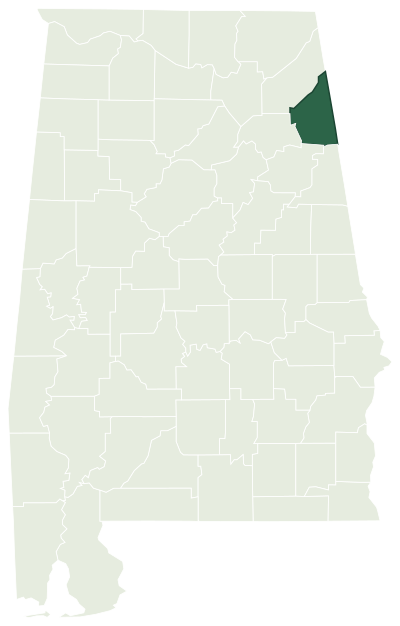
Cherokee County sits in Alabama’s northeast corner against the Georgia line, roughly between Birmingham, Atlanta and Chattanooga. Weiss Lake fills much of its middle, and the economy mixes farming, lake tourism and a handful of manufacturers. The biggest of those builds steel parts for cars. Crane jobs here are spread out, so the operators and riggers who hold certifications tend to be the ones contractors call first.
Manufacturing in Leesburg and Centre
As of the county’s most recent published employer list, KTH Leesburg Products was the largest manufacturer, with more than 460 workers making automotive underbody structural parts. Stamping and welding lines depend on overhead cranes to move dies and steel, and plant expansions bring in mobile cranes and riggers. Prince Minerals, which makes porcelain enamel frits, and an apparel plant also appear among the major employers.
The Cherokee County Industrial Development Authority keeps a list of sites and buildings for new industry. When a site gets a tenant, the building and equipment installation that follows is crane work.
Leesburg sits on U.S. 411 just west of the lake, and Centre is a short drive northeast, so most plant work in the county is within easy reach of either town.
Building around Weiss Lake
Weiss Lake on the Coosa River is known as the Crappie Capital of the World, and the shoreline sees homes, docks, seawalls and marina work. Lake lots are often sloped, narrow and close to the water, so contractors use smaller hydraulic and boom truck cranes and need operators who can set up carefully on uneven or soft ground. Picks over water and near docks call for good communication between operator and signal person.
Rural roads and power lines across the county also keep utility crews busy, and setting poles with a digger derrick is its own certification.
Seawall and dock builders often work from barges or from the bank with a small crane reaching out over the water. Knowing how radius changes capacity, and how a swinging load acts when the barge moves, is exactly the kind of knowledge the written exams measure.
Courses suited to the county
- Service truck crane operator for mechanics and service fleets with truck-mounted cranes
- Mobile crane operator for plant expansions and residential lake construction
- Digger derrick operator for pole setting on rural lines
- Signal person for lifts over water or out of the operator’s view
Who sets the rules
Alabama never created a state OSHA plan, so the federal agency enforces crane safety at Cherokee County’s private workplaces. Its construction crane standard, Subpart CC, expects an operator to be certified through an accredited program and evaluated by the employer, and expects riggers and signal persons to be qualified. Alabama has no state crane license, and Centre and Leesburg do not issue one. Georgia, across the line, is also a federal OSHA state without a general crane license.
Owners of small businesses can get a free, confidential safety consultation from UA SafeState at the University of Alabama; consultants do not cite or fine. See Alabama crane certification requirements for more.
Questions people ask
Where do Cherokee County candidates usually test?
Practical exams are taken in person at a practical test site, which for northeast Alabama often means traveling toward Gadsden, Birmingham or north Georgia. Written exams can be taken through online proctoring or at a computer test center.
Is a service truck crane certification enough for my job?
If you only run a truck-mounted service crane within its limits, the restricted service truck crane (STC) certification may be all you need. If you also run larger telescopic cranes, look at the full mobile crane operator course. Your employer decides which equipment you are evaluated on.
What weather should crane crews plan around?
Summers are hot and humid with afternoon storms, spring brings tornado watches, and winters can bring an occasional freeze or ice. Wind across the open lake can be stronger than in the surrounding hills.
Can I study a little at a time?
Yes. The course is self-paced on phone, tablet or laptop, so short sessions at lunch or in the evening add up.
Last reviewed · How we research these pages
Suggested prep for this area
-
Service Truck Crane
Self-paced preparation for the NCCCO Service Truck Crane written exam, a restricted credential for the small telescopic cranes mounted on Alabama mechanics and field service trucks.
-
Mobile Crane Operator
Self-paced study for the NCCCO mobile crane Core exam and the LAT, TLL and TSS specialty exams, organized around the hydraulic and lattice machines Alabama contractors actually rent and own.
-
Digger Derrick
Online preparation for the NCCCO Digger Derrick Operator written exam, written around the storm-restoration and system-hardening work that keeps Alabama line crews busy.
-
Signalperson
Self-paced preparation for the NCCCO Signalperson written exam, covering the standard hand signals, voice communication, crane behavior and the OSHA rules that decide when a signal person is required.
Close by
Line up your crane exam prep for work in Alabama
Send us the card you need, whether that's operator, rigger, signal person or a recert, and the part of Alabama you work in. An enrollment advisor writes back with a matching course and the steps for booking your written and practical exams.
- Self-paced lessons that open on any phone or laptop
- Practice questions in the style of the NCCCO written tests
- Advice on where Alabama candidates set up practical exams
Ask about enrollment
A few short fields. Your details are used only to reply to you.