Anniston · Oxford · Jacksonville
Calhoun County Crane Training for Defense, Foundry and Steel Work
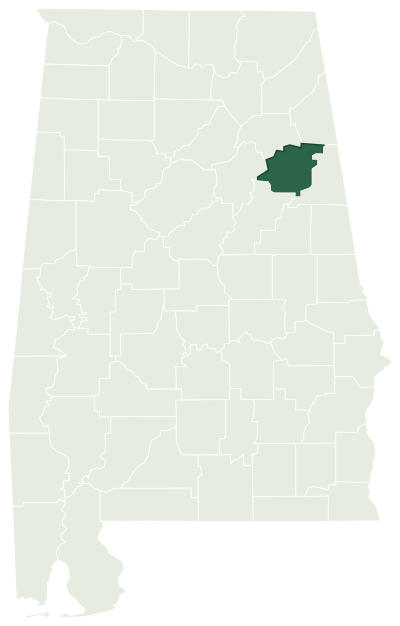
Few Alabama counties have as many heavy industrial employers in such a small area. Calhoun County combines a large Army maintenance depot, defense contractors, a transit bus plant, a ductile iron foundry and a structural steel supplier, all within a short drive of Anniston, Oxford and Jacksonville. Heavy vehicles, castings and steel beams all move by crane, and the people rigging and running those lifts need to know their stuff.
A county built on heavy equipment
Anniston Army Depot near Bynum repairs and overhauls M1 Abrams tanks along with Stryker and AMPV vehicles. Business Alabama reports that the depot employs more than 3,000 people, and its 2025 economic impact study credited it with $944 million in statewide impact. Tanks and armored hulls are among the heaviest items handled by overhead and mobile cranes anywhere in the state.
Defense contractors work alongside it: General Dynamics Land Systems builds armored vehicles and BAE Systems rehabilitates military vehicles in the county. New Flyer assembles transit buses in Anniston with roughly 650 employees, and Bridgewater Interiors and International Automotive Components supply seating and interiors to the region’s auto plants.
Castings and structural steel
Tyler Union casts ductile iron water main fittings in Anniston, employing around 500 people. Foundry work means ladles, molds and finished castings on crane hooks all day. FabArc Steel Supply, with about 305 workers, supplies structural steel, and its product goes out on trucks to be erected by crane on job sites around the Southeast.
Shop crane operators who handle castings and steel are often the first people their employers send for certification when the company starts doing field erection or equipment installs.
Water main fittings and structural members are irregular, heavy and often long, which makes center of gravity, sling angle and tag line use more than exam vocabulary in this county.
Course picks for Calhoun County
- Mobile crane operator for steel erection and plant equipment moves
- Rigger Level 2 for heavy, odd-shaped loads like hulls and castings
- Signal person for congested shop floors and multi-crane picks
- Tower crane operator for larger commercial and campus construction
- Mobile crane recertification for experienced depot and contractor operators nearing their five-year renewal
Federal rules, local specifics
Crane safety for private employers in Calhoun County is enforced by federal OSHA, because Alabama operates no state plan. The Birmingham area office is the nearer one. Construction cranes are governed by Subpart CC, which requires certification from an accredited testing body and an employer evaluation before anyone runs a crane on a job. In-plant overhead cranes fall under 1910.179. There is no state or city crane license in Alabama.
Work inside federal facilities like the depot may also carry Army safety requirements that go beyond OSHA, so ask the project or contracting office what credentials they expect. Our requirements guide covers the OSHA side.
Ridges and storm season
Calhoun County lies in the Appalachian foothills, with ridges running northeast to southwest. Sloping sites, wind channeled through gaps, and spring tornado outbreaks are all part of the local picture. Summers are hot and humid, and thunderstorms regularly force lift crews to stand down until lightning clears.
Questions people ask
Is this page different from the Anniston, Oxford and Jacksonville pages?
Yes. Those cities have their own pages. This one covers the whole county, including Piedmont, Weaver, Hobson City, Ohatchee and the depot area at Bynum.
How far is the nearest big metro?
Anniston is roughly 60 miles east of Birmingham along I-20 and about 90 miles west of Atlanta. Practical exams are taken in person at a test site, and the written exams can be taken through online proctoring.
I run an overhead crane at a plant. Is that the same exam?
No. NCCCO’s mobile, tower and articulating exams cover those machine types. In-plant overhead cranes are generally governed by 29 CFR 1910.179, and employers train and qualify those operators under that standard. If your job may move into field erection, a mobile crane certification is the usual next step.
Can I study around rotating shifts?
Yes. The course is self-paced and open 24/7 on any device, so night and weekend shifts are not a problem.
Last reviewed · How we research these pages
Suggested prep for this area
-
Mobile Crane Operator
Self-paced study for the NCCCO mobile crane Core exam and the LAT, TLL and TSS specialty exams, organized around the hydraulic and lattice machines Alabama contractors actually rent and own.
-
Rigger II
Self-paced written-exam preparation for NCCCO Rigger Level II, the advanced credential for riggers who work out weights and centers of gravity themselves and set up non-routine picks.
-
Signalperson
Self-paced preparation for the NCCCO Signalperson written exam, covering the standard hand signals, voice communication, crane behavior and the OSHA rules that decide when a signal person is required.
-
Tower Crane Operator
Written exam preparation for NCCCO Tower Crane Operator certification, aimed at Alabama operators who follow a small, mobile fleet of tower cranes between metro, campus and coastal jobs.
Towns and cities in Calhoun County
Close by
Line up your crane exam prep for work in Alabama
Send us the card you need, whether that's operator, rigger, signal person or a recert, and the part of Alabama you work in. An enrollment advisor writes back with a matching course and the steps for booking your written and practical exams.
- Self-paced lessons that open on any phone or laptop
- Practice questions in the style of the NCCCO written tests
- Advice on where Alabama candidates set up practical exams
Ask about enrollment
A few short fields. Your details are used only to reply to you.