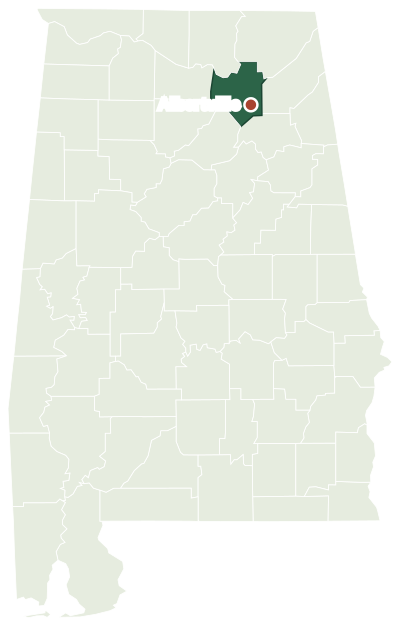
Marshall County · Sand Mountain
Albertville Crane and Rigging Exam Prep
In 1991 Albertville started calling itself the Fire Hydrant Capital of the World, a title it earned after Mueller moved its hydrant production here in 1975. Iron hydrants, railcar parts and an enormous poultry industry make this Sand Mountain city a place where heavy things get lifted every shift. Our self-paced online course helps local operators, riggers and signal persons prepare for the written exams behind nationally accredited crane certifications.
Foundries, rail parts and poultry lines
Mueller's Albertville plant is an ISO 9001 registered facility that produces fire hydrants to AWWA C502 standards. Hydrant bodies and barrels are heavy iron castings, and finished hydrants leave on pallets and flatbeds. In a plant like that, overhead cranes handle much of the internal movement, while mobile cranes come in for equipment installs, roof work and expansion.
Progress Rail makes railcar components at its Albertville plant. Rail parts are dense, awkward and often irregular in shape, the kind of loads where knowing the center of gravity and choosing the right hitch matter more than raw capacity.
Poultry is the biggest sector in the area. Alabama lawmakers chose Albertville for north Alabama's first commercial poultry processing plant after World War II, and Tyson Foods operates a processing facility here today. Wholesale grocer Mitchell Grocery, founded in 1945, Newman Technology and Huhtamaki round out the local industrial list. Processing plants and distribution centers mean frequent refrigeration, rooftop air handling and conveyor work.
Lifting on top of the mountain
Sand Mountain is a broad plateau, so most Albertville sites are fairly level, but the edges drop off steeply toward the Tennessee River valley and Lake Guntersville. Ground here can be sandy loam over rock, and rain changes bearing capacity quickly. North Alabama's spring storm season brings tornado watches, and summer storms pop up most afternoons. Wind on an open plateau site can build without much warning, so operators should know their crane's wind limits and track gusts at boom height.
Plant expansions here often happen while production keeps running. That means lifts over or beside working areas, tight windows during shift changes, and coordination with plant safety staff on exclusion zones. Operators and riggers who can read a lift plan and explain it clearly to plant personnel make those jobs go smoother.
Alabama's approach to crane qualification
Alabama does not hand out a crane operator license, and Albertville doesn't either. Federal OSHA covers private workplaces in the state. For construction work, 29 CFR 1926.1427 requires operators to be certified by an accredited testing organization and evaluated by the employer; signal persons and riggers must meet the qualification rules in 1926.1428 and 1926.1425. Overhead cranes inside a plant fall under 29 CFR 1910.179. The requirements guide covers each case.
Where to start
- Mobile crane operator for contractors who set equipment at plants and distribution centers.
- Articulating crane operator for drivers delivering pipe, hydrants and building materials.
- Rigger Level I for maintenance and production workers who hook castings and parts.
- Signal person for anyone guiding a load into a building or a truck bed.
Questions people ask
How far is the drive for Albertville candidates who need a practical exam?
Huntsville is roughly 45 miles north and Birmingham is about 75 miles southwest, and both areas see practical exam activity. Some employers also bring test events to their own yards. Exams are booked through the certifying body.
Can I study between poultry plant shifts?
Yes. The course is open 24 hours a day on any phone, tablet or computer, so you can study in short sessions on breaks or after a shift.
Is an articulating crane on a delivery truck covered by OSHA's crane rule?
Usually, yes. Articulating cranes used in construction fall under Subpart CC, though delivering materials to the ground without arranging them can be exempt. Certification is often required by the employer even when the exemption applies.
Do you offer group enrollment for plant crews?
Yes. Send the number of workers and courses through the enrollment form.
Last reviewed · How we research these pages
Suggested prep for this area
-
Mobile Crane Operator
Self-paced study for the NCCCO mobile crane Core exam and the LAT, TLL and TSS specialty exams, organized around the hydraulic and lattice machines Alabama contractors actually rent and own.
-
Articulating Crane
Online written exam prep for the three NCCCO articulating crane designations, with a plain explanation of when an Alabama delivery stops being a delivery and becomes crane work.
-
Rigger I
Online written-exam study for the NCCCO Rigger Level I credential: the person who selects gear, inspects it and attaches routine loads whose weight and balance point are already known.
-
Signalperson
Self-paced preparation for the NCCCO Signalperson written exam, covering the standard hand signals, voice communication, crane behavior and the OSHA rules that decide when a signal person is required.
Close by
Line up your crane exam prep for work in Alabama
Send us the card you need, whether that's operator, rigger, signal person or a recert, and the part of Alabama you work in. An enrollment advisor writes back with a matching course and the steps for booking your written and practical exams.
- Self-paced lessons that open on any phone or laptop
- Practice questions in the style of the NCCCO written tests
- Advice on where Alabama candidates set up practical exams
Ask about enrollment
A few short fields. Your details are used only to reply to you.