Hamilton · Guin · Corridor X
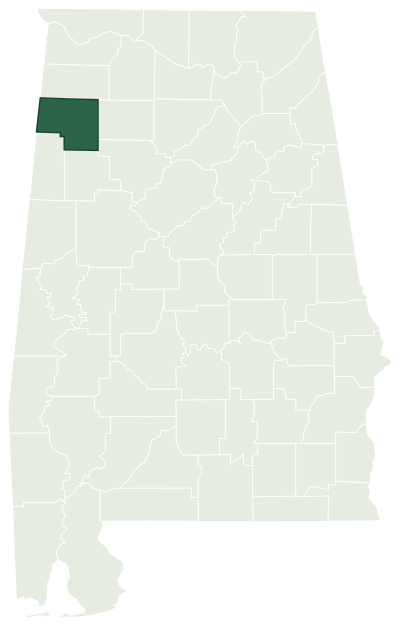
Marion County Crane Exam Prep, From Hamilton to Guin
Marion County is factory country in a rural setting. Much of its business activity lines the U.S. 78 route known as Corridor X southwest of Hamilton, the four-lane link between Memphis and Birmingham. Manufactured-home builders, a decades-old 3M plant in Guin, a bearing maker and a cluster of metal shops make up the core employers. Not every plant runs a mobile crane, but almost every one of them depends on overhead cranes, boom trucks and the people who rig loads safely.
Houses built indoors, then hauled out
Manufactured housing is Marion County's signature industry. Regional business coverage names Deer Valley Homebuilders, Buccaneer Home Builders, Hamilton Home Builders and TRU Homes among the county's largest manufacturers. Inside these plants, wall panels, roof trusses and finished sections move down the line on overhead bridge cranes and gantries, and a dropped load in a plant full of workers is a serious event.
That is why plant safety managers pay attention to rigging. Choosing the right sling, inspecting spreader bars and knowing when a hook latch has failed are everyday skills for line workers here. Rigger Level 1 is a practical credential for anyone who hooks loads on a production floor.
Guin, Hamilton and the metal trades
3M has operated in Guin since 1955, and manufacturing employs nearly 28 percent of Guin's workforce according to Census estimates cited by the town's development agency. NTN Bower, Wrangler and Harden Manufacturing are other long-standing county employers. In Hamilton, manufacturing accounts for roughly a quarter of jobs, and the city has been developing a second industrial park.
When a new park fills, building pads get graded, steel frames go up and production equipment arrives on flatbeds. Local boom-truck operators and regional crane companies handle most of that work, and general contractors expect them to show certification for the machines they run.
Plant cranes and job-site cranes are covered differently
Inside a factory, permanent overhead and gantry cranes are general industry equipment regulated under 29 CFR 1910.179. Truck and crawler cranes used in general industry fall under 1910.180. Once a crane is used for construction, such as erecting a new building or installing a large press, the construction rules in Subpart CC apply.
Under those construction rules, 1926.1427 requires the operator to hold an accredited certification and pass an employer evaluation, 1926.1428 requires a qualified signal person when the operator can't see the load or the path, and 1926.1404 and 1926.1425 require qualified riggers for certain tasks. Alabama has no crane license of its own, and federal OSHA enforces these standards for private employers. UA SafeState offers free, confidential consultations to Alabama employers who want a second set of eyes on their program.
Studying in a small county
Marion County is a long drive from Birmingham, so avoiding extra trips matters. Our prep runs on a phone, tablet or laptop and is available around the clock. When you feel ready, you can take the NCCCO written exam by Online Proctored Testing, at a computer test center or at a test event. The practical exam is always in person, at an accredited site, and online study doesn't replace it.
Plan field lifts around the weather, too. Northwest Alabama sees strong spring storms and tornado watches, and summer heat in a metal building or on a hot deck tires crews faster than people expect.
Questions people ask
Do overhead crane operators in a plant need NCCCO?
The general industry rule requires that overhead crane operators be trained and designated by the employer; it does not mandate NCCCO the way the construction rule does. Many employers still choose accredited rigging or signal training for their crews.
What credential suits a boom truck delivering trusses?
It depends on the truck. Knuckle-boom units fit the Articulating Crane Operator program, while fixed-cab telescopic boom trucks fall under the TSS specialty of the mobile crane program.
How long does certification last?
Five years, then you recertify with a written exam. Documented crane-related experience of 1,000 hours during the period can waive the recert practical.
Last reviewed · How we research these pages
Suggested prep for this area
-
Rigger I
Online written-exam study for the NCCCO Rigger Level I credential: the person who selects gear, inspects it and attaches routine loads whose weight and balance point are already known.
-
Articulating Crane
Online written exam prep for the three NCCCO articulating crane designations, with a plain explanation of when an Alabama delivery stops being a delivery and becomes crane work.
-
Signalperson
Self-paced preparation for the NCCCO Signalperson written exam, covering the standard hand signals, voice communication, crane behavior and the OSHA rules that decide when a signal person is required.
-
Mobile Crane Operator
Self-paced study for the NCCCO mobile crane Core exam and the LAT, TLL and TSS specialty exams, organized around the hydraulic and lattice machines Alabama contractors actually rent and own.
Close by
Line up your crane exam prep for work in Alabama
Send us the card you need, whether that's operator, rigger, signal person or a recert, and the part of Alabama you work in. An enrollment advisor writes back with a matching course and the steps for booking your written and practical exams.
- Self-paced lessons that open on any phone or laptop
- Practice questions in the style of the NCCCO written tests
- Advice on where Alabama candidates set up practical exams
Ask about enrollment
A few short fields. Your details are used only to reply to you.