West Alabama · Fayette · Berry · Belk
Fayette County Crane Certification for Plant, Mill and Steel Shop Crews
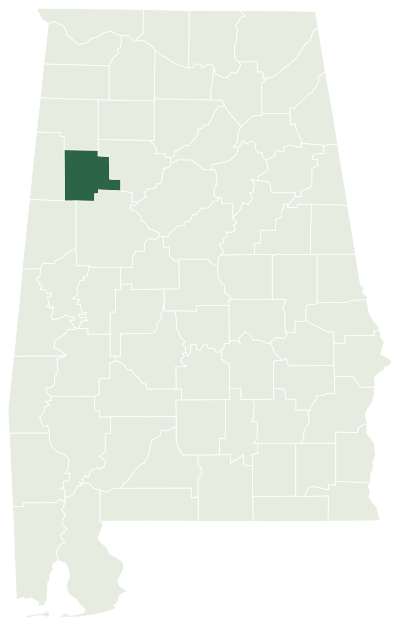
Fayette County is rural west Alabama: pine forest, small towns and a manufacturing base that carries more weight than its population suggests. Across the three-county area that includes Fayette, Lamar and Marion, roughly a third of workers hold manufacturing jobs. In Fayette County that means a nitrile glove maker, sawmills and lumber remanufacturing, and a new steel fabrication plant. Each depends on equipment that someone has to lift, place and maintain. For the operators and riggers who do that work, our online prep offers a way to study for an accredited certification without leaving the county.
Industry in a small county
Showa Group, which makes nitrile gloves, is Fayette County’s largest employer. Glove lines run long dipping and curing equipment, and changing or adding a line is a substantial rigging project. Interfor, which took over a former Georgia-Pacific sawmill, is another of the county’s largest employers, and Lumber Remanufacturing Services operates in Belk.
The newest arrival is O’Neal Manufacturing Services, which opened a steel fabrication facility in the former Fayette Fabrication building and expects to create 70 full-time jobs. Fabrication shops move steel all day with overhead cranes, and their finished products head out to job sites where mobile cranes take over.
Courses for west Alabama work
Most people in Fayette County who need a crane credential fall into one of these groups.
- Steel shop and erection crews: Rigger Level 1 and Mobile Crane Operator
- Truck drivers delivering lumber, trusses and steel with a knuckle boom: Articulating Crane Operator
- Rural electric and utility line crews: Digger Derrick Operator
Compliance without a state license
You won’t find a crane license in Alabama’s statutes or in Fayette’s city code. Private employers in the county fall under federal OSHA, which works from area offices in Birmingham and Mobile. On construction sites, 29 CFR 1926.1427 requires operator certification from an accredited body together with an employer evaluation; 1926.1428 and 1926.1425 add qualified signal persons and riggers. Production overhead cranes fall under 1910.179.
Surface mines and quarries are different. Coal and aggregate operations in west Alabama are regulated by MSHA rather than OSHA, so the Subpart CC certification rule doesn’t govern cranes used on mine property. Ask your employer which agency covers your site. Our requirements guide explains further.
Ground and weather to plan around
Hilly, wooded terrain and clay soils are common across Fayette County, and logging roads and mill yards rut deeply after rain. West Alabama sits in an active tornado corridor, with spring and late fall outbreaks, and summer thunderstorms bring lightning and sudden gusts. Plan the setup before the crane arrives: firm, level ground, mats sized for outrigger loads, a clear swing path and a weather check before every critical pick. The written exams test each of those decisions.
Where and how to test
Written exams are offered through Online Proctored Testing, at computer test centers and at test events. The practical exam is always taken hands-on at a practical test site, and online study can’t replace it. Tuscaloosa is under an hour southeast of Fayette, and Birmingham is a little farther east, so practical testing is within a day trip. Crew enrollment is available, and an enrollment advisor replies through the form.
Questions people ask
Is crane work at a coal mine covered by the OSHA certification rule?
No. Mines fall under MSHA, which has its own requirements. Some mine contractors still require accredited certification as company policy.
I run a knuckle-boom truck delivering lumber. Do I need certification?
It depends on the job. Many deliveries of building materials to construction sites fall under Subpart CC, with some exceptions. Ask your employer; our Articulating Crane course covers that exam.
What does recertification involve?
Every five years you pass a written recertification exam. If you logged 1,000 hours of crane-related experience in that time, the practical retest can be waived.
Last reviewed · How we research these pages
Suggested prep for this area
-
Rigger I
Online written-exam study for the NCCCO Rigger Level I credential: the person who selects gear, inspects it and attaches routine loads whose weight and balance point are already known.
-
Mobile Crane Operator
Self-paced study for the NCCCO mobile crane Core exam and the LAT, TLL and TSS specialty exams, organized around the hydraulic and lattice machines Alabama contractors actually rent and own.
-
Articulating Crane
Online written exam prep for the three NCCCO articulating crane designations, with a plain explanation of when an Alabama delivery stops being a delivery and becomes crane work.
-
Digger Derrick
Online preparation for the NCCCO Digger Derrick Operator written exam, written around the storm-restoration and system-hardening work that keeps Alabama line crews busy.
Close by
Line up your crane exam prep for work in Alabama
Send us the card you need, whether that's operator, rigger, signal person or a recert, and the part of Alabama you work in. An enrollment advisor writes back with a matching course and the steps for booking your written and practical exams.
- Self-paced lessons that open on any phone or laptop
- Practice questions in the style of the NCCCO written tests
- Advice on where Alabama candidates set up practical exams
Ask about enrollment
A few short fields. Your details are used only to reply to you.