Heflin · Ranburne · Fruithurst
Crane Certification Prep Along I-20 in Cleburne County
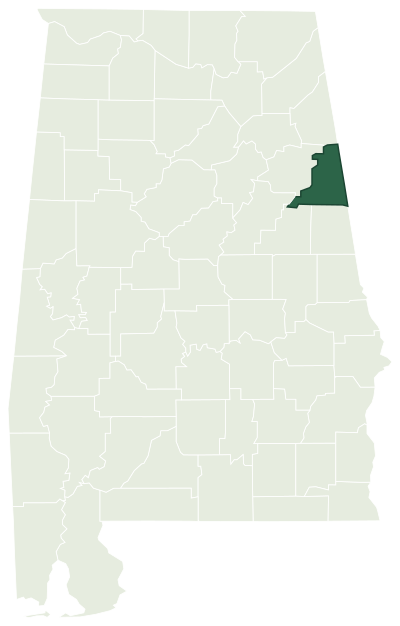
Cleburne County is the last stop in Alabama before Georgia on Interstate 20, and it pulls work from both directions. Atlanta contractors and Anniston fabricators pass through Heflin daily, and the county’s biggest plant is in the middle of a major expansion. The north and west are steep, forested ridges in the Talladega National Forest. That mix of factory construction, interstate traffic and mountain ground makes careful crane work a daily concern. Our online course is built for people who want to earn a national certification while still working full weeks.
Southwire’s expansion and what it means for crews
Southwire’s Heflin wire and cable plant opened in 1996 as Forte Power Systems. In late 2025 the company announced a $176 million expansion, its fourth at the site, adding about 340,000 square feet and more than 85 jobs, with new capacity expected online in late 2027.
Building on that scale means steel erection, precast and roof equipment picks, and later the installation of heavy production lines and cable reels inside the finished building. Contractors on a job like this expect operators who are certified, signal persons who can direct blind lifts and riggers who can rig machinery without damaging it. Manufacturing is already the county’s largest job sector, followed by education, health care and construction.
Courses that suit local work
- Mobile crane operator for steel, precast and equipment picks on plant construction
- Rigger Level 2 for machinery moves and multi-crane plans
- Signal person for crowded sites where the operator cannot see the hook
- Tower crane operator for operators who follow work toward Atlanta and Birmingham high-rises
Mountain sites and Southern weather
The Shoal Creek and Talladega districts of the Talladega National Forest extend into Cleburne County, and much of the land was heavily logged and eroded before the federal purchase in the 1930s. Work in this terrain, from cell towers to utility lines to forest service bridges, often means narrow pads, steep approaches and fill that has not been compacted.
Spring storms can bring tornadoes along the I-20 corridor, and summer brings high heat, humidity and lightning almost every afternoon. Questions about ground bearing pressure, outrigger mats, wind and staying clear of power lines are on every written exam for good reason.
Two states, one national card
Many Cleburne County operators work in Georgia as often as Alabama. Neither state issues a general crane operator license, and both rely on federal OSHA. That makes an accredited national certification the credential that travels. On construction sites, OSHA’s 1926.1427 requires that certification along with an employer evaluation; 1926.1425 and 1926.1428 set qualification standards for riggers and signal persons. In-plant overhead cranes, like those at a wire mill, fall under 1910.179.
Federal OSHA covers Alabama’s private employers through area offices in Birmingham and Mobile. Our Alabama requirements guide covers the details.
Getting tested
You can sit the written exams through online proctoring, at a computer test center or at a scheduled test event. The practical is a hands-on test at a practical site and cannot be done online. From Heflin, Anniston is close by, and both Birmingham and Atlanta are reachable in well under two hours on I-20. Contractors can enroll several people at once through the enrollment form.
Questions people ask
Will a Georgia contractor accept my Alabama-earned certification?
Yes. NCCCO certification is national and does not depend on where you test. Georgia does not issue its own general crane license.
Do I need a separate card to run the overhead cranes inside the Southwire plant?
Plant overhead cranes fall under general industry rules, which require training and qualification. Some employers ask for an overhead crane credential, but the NCCCO mobile crane card is aimed at construction cranes.
Can I study if I work a long commute to Atlanta?
Yes, as long as you are not the driver. The course runs on a phone or tablet and saves your progress between sessions.
Which course comes first for a new hand on a steel crew?
Rigger Level 1 and signal person are common starting points, since they cover hooking, hitches and hand signals you will use from day one.
Last reviewed · How we research these pages
Suggested prep for this area
-
Mobile Crane Operator
Self-paced study for the NCCCO mobile crane Core exam and the LAT, TLL and TSS specialty exams, organized around the hydraulic and lattice machines Alabama contractors actually rent and own.
-
Rigger II
Self-paced written-exam preparation for NCCCO Rigger Level II, the advanced credential for riggers who work out weights and centers of gravity themselves and set up non-routine picks.
-
Signalperson
Self-paced preparation for the NCCCO Signalperson written exam, covering the standard hand signals, voice communication, crane behavior and the OSHA rules that decide when a signal person is required.
-
Tower Crane Operator
Written exam preparation for NCCCO Tower Crane Operator certification, aimed at Alabama operators who follow a small, mobile fleet of tower cranes between metro, campus and coastal jobs.
Close by
Line up your crane exam prep for work in Alabama
Send us the card you need, whether that's operator, rigger, signal person or a recert, and the part of Alabama you work in. An enrollment advisor writes back with a matching course and the steps for booking your written and practical exams.
- Self-paced lessons that open on any phone or laptop
- Practice questions in the style of the NCCCO written tests
- Advice on where Alabama candidates set up practical exams
Ask about enrollment
A few short fields. Your details are used only to reply to you.