Greensboro · Moundville · Black Warrior River
Hale County Operators and Riggers: Prepare for Certification Online
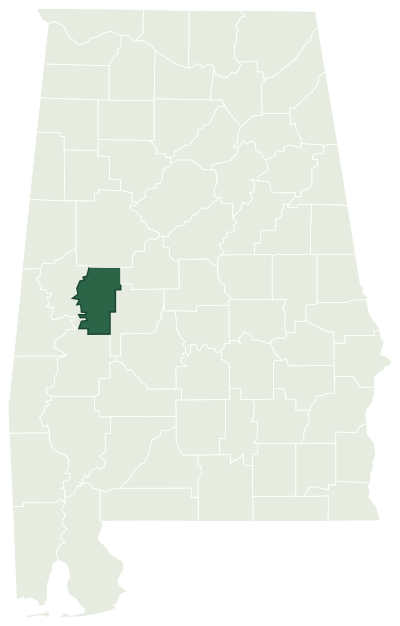
Ask anyone in west Alabama what Hale County is known for and catfish comes up quickly. Greensboro calls itself the catfish capital, and in the 2022 Census of Agriculture catfish sales made up more than half of the county’s farm income. The ponds, feed mills and processing plants behind that number, along with timber and the Black Warrior River on the county’s western edge, create steady work for people who rig and lift. This page explains how a Hale County worker can prepare for a national crane or rigging certification without driving to a classroom.
Catfish country runs on equipment
Alabama’s catfish industry got its start in Greensboro in 1960 with a small channel catfish hatchery, and Hale, Dallas and Greene counties still lead the state. Twenty catfish operations in Hale reported roughly $36.5 million in sales in the most recent ag census. Every one of those farms depends on aerators, pumps, feed bins and hauling equipment, and the plants that process the fish need refrigeration units, conveyors and stainless lines installed and replaced.
That work is usually done with boom trucks, small hydraulic cranes and articulating units rather than large lattice machines. If that describes your day, the service truck crane or articulating crane program is often the right fit, paired with Rigger Level 1.
Timber and the river
Forests along the Black Warrior drew timber companies long before catfish ponds were dug, and logging, sawmilling and pole work remain part of the local economy. Loading logs is handled by knuckle-boom loaders that usually fall outside the construction crane rule, but the same crews often take on bridge, building or utility jobs where certification is expected.
The river itself has lock and dam facilities and public landings near Greensboro. Marine and shoreline lifts happen on soft, damp ground, and an operator who understands soil bearing and outrigger mats is far less likely to have a bad day.
Heat, storms and a wet spring
West Alabama summers are long and humid, and pop-up thunderstorms bring lightning and gusts with little warning. Spring is tornado season across the Black Belt. Both affect lifting: wind changes how a load swings, and a crew needs a clear rule for when to land it. The signal person material covers stopping a lift and the standard hand signals for doing it safely.
High water on the Black Warrior after a stretch of rain can leave access roads and pond levees soft for days. Before a truck crane rolls onto a levee or a shoulder, someone should check what the ground can hold and plan mats or cribbing to spread the load. Skipping that step is how outriggers punch through.
Certification facts for Hale County
Alabama doesn’t license crane operators. Instead, private employers answer to federal OSHA, and its construction crane standard requires a certified operator who has also been evaluated by the employer (29 CFR 1926.1427). Signal persons and riggers have their own qualification rules in 1926.1428 and 1926.1425/1926.1404. Credentials from NCCCO are good for five years.
Our course covers the written side. You still schedule the written exam with the certifying body, either through Online Proctored Testing or at a test center or event, and the hands-on practical is taken on a real crane at a practical test site. Most Greensboro and Moundville residents head toward Tuscaloosa for that. The requirements guide walks through the whole process.
Questions people ask
Does a feed mill or processing plant count as construction?
Routine plant maintenance with an overhead or gantry crane falls under general industry rules (29 CFR 1910.179 and 1910.180). New construction, demolition and major installations at the same site fall under Subpart CC. Many employers simply certify their operators either way.
I work nights. When can I study?
Any time. The course is open 24/7 and saves where you stopped, so you can pick it up on a phone between shifts.
Can a farm or contractor enroll several workers at once?
Yes. Use the enrollment form to ask about crew enrollment, and an enrollment advisor will reply.
Last reviewed · How we research these pages
Suggested prep for this area
-
Service Truck Crane
Self-paced preparation for the NCCCO Service Truck Crane written exam, a restricted credential for the small telescopic cranes mounted on Alabama mechanics and field service trucks.
-
Articulating Crane
Online written exam prep for the three NCCCO articulating crane designations, with a plain explanation of when an Alabama delivery stops being a delivery and becomes crane work.
-
Rigger I
Online written-exam study for the NCCCO Rigger Level I credential: the person who selects gear, inspects it and attaches routine loads whose weight and balance point are already known.
-
Signalperson
Self-paced preparation for the NCCCO Signalperson written exam, covering the standard hand signals, voice communication, crane behavior and the OSHA rules that decide when a signal person is required.
Close by
Line up your crane exam prep for work in Alabama
Send us the card you need, whether that's operator, rigger, signal person or a recert, and the part of Alabama you work in. An enrollment advisor writes back with a matching course and the steps for booking your written and practical exams.
- Self-paced lessons that open on any phone or laptop
- Practice questions in the style of the NCCCO written tests
- Advice on where Alabama candidates set up practical exams
Ask about enrollment
A few short fields. Your details are used only to reply to you.