Evergreen · Castleberry · Repton
Getting Certified to Run Cranes in Conecuh County
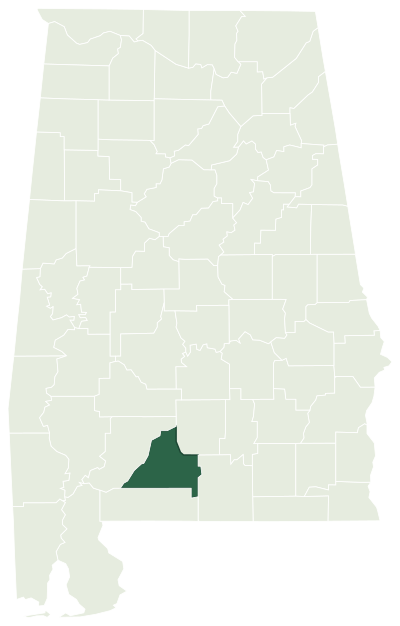
Drive I-65 between Montgomery and Mobile and you pass right through Evergreen, Conecuh County’s seat and its industrial center. Plants there make auto parts, geogrids and bus windows; the county’s namesake sausage company is still a major employer; and south toward Castleberry, timber is king. Manufacturing is the county’s largest employment category. If your job puts you near a hook, a national crane or rigging certification is worth having, and our self-paced course lets you study for the written exams without leaving the county.
Who runs cranes in Conecuh County
Guyoung Tech USA, an automotive stamping supplier, is the largest manufacturing employer in the county and has been expanding. Stamping plants rely on overhead cranes to change dies that can weigh many tons, and new press lines are set by contract crane and rigging crews.
The City of Evergreen’s industry list also includes Knud Nielsen Company, Conecuh Sausage, Tenax Manufacturing, which produces geogrids and geocomposites, and Transportation Products, which makes bus and truck windows. Conecuh Sausage has been in Evergreen since 1947. Down the road, Weyerhaeuser in Castleberry ranks among the county’s biggest employers and keeps log handling, equipment maintenance and mill work going.
Geogrid and geocomposite production at Tenax relies on large rolls and heavy tooling, and window and decor plants move pallets and fixtures with hoists. Even where the crane is a small one, a slipped hitch or an overloaded sling is a serious injury risk, which is why rigging knowledge is valued across all of these employers.
Courses we suggest
- Rigger Level 1 for die changes, machine moves and plant maintenance
- Mobile crane operator for contractors working plant expansions and I-65 projects
- Articulating crane operator for material delivery and setting
- Signal person for helpers and laborers who direct lifts
No state license, but a firm federal rule
You will not get a crane license from Alabama or from Evergreen. On construction projects, though, federal OSHA is clear: an operator needs a certification from an accredited body and must be evaluated by the employer, per 29 CFR 1926.1427. A signal person must meet 1926.1428, and anyone rigging loads must be qualified under 1926.1425. Plant cranes and hoists are covered separately by the general industry standard at 1910.179.
Federal OSHA is the enforcing agency for private employers here; the agency has Alabama area offices in Birmingham and Mobile. Our requirements overview walks through the rules step by step.
South Alabama weather on the job
Conecuh County lies within reach of Gulf hurricanes and tropical storms, which can bring days of rain and strong gusts well inland. Summer heat and humidity are routine, and afternoon storms can roll in quickly with lightning. A competent operator watches the forecast, knows the manufacturer’s wind limits and checks that ground under outriggers has not softened. Expect written exam questions on each of those points.
Exam logistics
For the written exams, you can choose online proctored testing, a computer test center or a test event. The practical exam is taken hands-on at a practical site, and no online course replaces it. Evergreen is about midway between Montgomery and Mobile on I-65, so candidates can look for testing in either city. Nearby Brewton and Escambia County employers draw from the same labor pool.
Companies that want to enroll a group can say so on the enrollment form, and an advisor will follow up.
Questions people ask
Do I need a crane certification to change dies in a stamping plant?
Overhead cranes in a plant fall under general industry rules, which require trained, qualified operators. An accredited card is not always mandatory there, but rigging training is very useful for heavy die work.
Can I take the written exam at home?
Yes, online proctored testing is one option, as long as your setup meets the testing body’s requirements. The practical still has to be done in person.
What does recertification involve?
Certifications last five years. You pass a written recert exam; 1,000 hours of crane-related experience during the period can waive the practical.
Does working on an I-65 bridge job require anything extra?
ALDOT projects and their contractors set job-specific rules, and an accredited operator certification is the federal baseline for construction cranes. Your employer must also evaluate you on the equipment you will run before you operate alone.
Last reviewed · How we research these pages
Suggested prep for this area
-
Rigger I
Online written-exam study for the NCCCO Rigger Level I credential: the person who selects gear, inspects it and attaches routine loads whose weight and balance point are already known.
-
Mobile Crane Operator
Self-paced study for the NCCCO mobile crane Core exam and the LAT, TLL and TSS specialty exams, organized around the hydraulic and lattice machines Alabama contractors actually rent and own.
-
Articulating Crane
Online written exam prep for the three NCCCO articulating crane designations, with a plain explanation of when an Alabama delivery stops being a delivery and becomes crane work.
-
Signalperson
Self-paced preparation for the NCCCO Signalperson written exam, covering the standard hand signals, voice communication, crane behavior and the OSHA rules that decide when a signal person is required.
Close by
Line up your crane exam prep for work in Alabama
Send us the card you need, whether that's operator, rigger, signal person or a recert, and the part of Alabama you work in. An enrollment advisor writes back with a matching course and the steps for booking your written and practical exams.
- Self-paced lessons that open on any phone or laptop
- Practice questions in the style of the NCCCO written tests
- Advice on where Alabama candidates set up practical exams
Ask about enrollment
A few short fields. Your details are used only to reply to you.